
Beyond the Badge - ASIS CPP PCI PSP


Understanding the Depth, Practicality, and Global Impact of the ASIS Certified Protection Professional (CPP)
The ASIS Certified Protection Professional (CPP) is more than a professional certification—it is the global benchmark for excellence in security management. Recognized across industries and continents, the CPP signifies not only technical competence but also the strategic mindset required to lead security programs in an increasingly complex risk landscape.
What sets the CPP apart is the remarkable depth and practicality of its Body of Knowledge. Its curriculum extends well beyond traditional security functions, encompassing enterprise risk management, organizational resilience, investigations, crisis management, business continuity, information security, physical security, and governance. Each domain is designed to mirror the realities faced by today's security leaders, ensuring that knowledge acquired through the certification translates directly into informed decision-making and measurable business value.
In this edition of Beyond the Badge, we examine why the CPP continues to be regarded as the gold standard in professional security certification. We explore the breadth of its curriculum, the practical relevance of its competencies, and the lasting global impact it has on professionals entrusted with protecting people, assets, operations, and organizational reputation.
Inside the Seven Domains of the CPP Body of Knowledge
The strength of the Certified Protection Professional (CPP) lies in the comprehensive nature of its Body of Knowledge. Structured across seven interrelated domains, the curriculum is designed to develop well-rounded security leaders capable of aligning protective strategies with organizational objectives, managing enterprise risks, and enhancing business resilience.
Each domain addresses a distinct pillar of security management while reinforcing the interconnected nature of modern protective programs. Collectively, they equip professionals with the knowledge and decision-making capabilities required to navigate complex operational environments, support executive leadership, and safeguard organizational assets.
In the following sections, we provide a high-level overview of each of the seven domains, highlighting their primary focus areas and the broad topics they encompass. Rather than serving as an exhaustive syllabus, this overview offers readers an appreciation of the remarkable depth, practical relevance, and strategic value embedded within the CPP Body of Knowledge.

Security Principles and Practices
Every robust security program begins with a strong foundation. The Security Principles and Practices domain establishes that foundation by introducing the core concepts, methodologies, and management practices that underpin effective security leadership. Rather than focusing solely on physical protection, this domain emphasizes a holistic approach to designing, implementing, governing, and continually improving security programs that support organizational objectives.
At its core, the domain encourages professionals to think strategically. Security leaders are expected to understand organizational priorities, develop governance frameworks, apply internationally recognized standards and best practices, and create policies that integrate security into everyday business operations. It reinforces the principle that security should function as a business enabler—protecting people, assets, information, and reputation while facilitating organizational growth and resilience.
The curriculum also introduces essential security management theories, risk-based decision-making, defense-in-depth strategies, Enterprise Security Risk Management (ESRM), security awareness initiatives, privacy considerations, and the importance of cross-functional collaboration. Equally important is the emphasis on continuous assessment and improvement, ensuring that security programs remain adaptive, measurable, and aligned with an organization's evolving risk landscape.
Key Areas of Coverage
Security management principles, theories, and organizational governance
Planning, developing, implementing, and evaluating security programs
Security policies, standards, procedures, and industry best practices
Enterprise Security Risk Management (ESRM) and risk-informed decision-making
Security program performance measurement, audits, and continuous improvement
Cross-functional collaboration and stakeholder engagement
Security awareness, education, and organizational security culture
Privacy principles, regulatory compliance, and protection of sensitive information
Executive Insight: Security Principles and Practices establishes the strategic mindset that distinguishes a security manager from a security leader. It provides the governance framework upon which every other CPP domain is built, ensuring that security becomes an integral component of organizational success rather than merely an operational function.

Business Principles and Practices
Exceptional security leaders are, first and foremost, business leaders. The Business Principles and Practices domain equips professionals with the knowledge required to align security initiatives with organizational strategy, financial performance, and operational excellence. It reinforces the principle that security is not merely a cost centre, but a strategic business function that creates measurable value, supports informed decision-making, and contributes to long-term organizational success.
This domain introduces the financial and managerial competencies expected of modern security executives. Professionals learn to interpret financial information, develop and manage budgets, evaluate investments through cost-benefit and return-on-investment (ROI) analyses, and ensure responsible stewardship of organizational resources. Equally important is the ability to develop effective policies, communicate with stakeholders, deliver impactful training, measure performance, and drive continuous improvement across security operations.
The curriculum also emphasizes productivity measurement, data-driven decision-making, regulatory awareness, and cross-functional collaboration. By integrating business management principles with security expertise, professionals develop the ability to communicate in the language of executive leadership, justify security investments, and demonstrate how well-designed security programs contribute directly to organizational resilience, operational efficiency, and sustainable growth.
Key Areas of Coverage
Management accounting, budgeting, financial planning, and fiduciary responsibility
Business finance principles, capital budgeting, and financial statement interpretation
Return on Investment (ROI), cost-benefit analysis, and investment justification
Budget planning, allocation, implementation, monitoring, and forecasting
Policy development, governance, standard operating procedures, and compliance
Executive communication, stakeholder engagement, and presentation techniques
Training design, delivery methodologies, and performance evaluation
Cross-functional collaboration and organizational alignment
Legal and regulatory frameworks affecting security operations
Productivity measurement, Key Performance Indicators (KPIs), and benchmarking
Data collection, analysis, interpretation, and performance reporting
Continuous improvement methodologies and business process optimization
Executive Insight: Business Principles and Practices transforms security professionals into strategic business partners. It develops the financial acumen, analytical thinking, and leadership capabilities required to demonstrate value, influence executive decisions, and ensure that security investments deliver measurable business outcomes.

Investigations
Effective investigations are fundamental to protecting organizational integrity, mitigating risk, and supporting informed decision-making. The Investigations domain equips security professionals with the knowledge and methodologies required to conduct objective, ethical, and legally defensible investigations into incidents that may affect people, assets, operations, or reputation. Whether addressing workplace misconduct, fraud, security breaches, or criminal activity, this domain emphasizes a disciplined approach to uncovering facts while maintaining professionalism, confidentiality, and procedural fairness.
The curriculum guides professionals through the complete investigative lifecycle—from planning and evidence collection to analysis, reporting, and post-investigation follow-up. It explores the legal and ethical frameworks governing investigations, effective interviewing techniques, evidence preservation, surveillance operations, workplace investigations, digital evidence, and case documentation. Throughout the process, emphasis is placed on critical thinking, objectivity, and the ability to distinguish facts from assumptions, ensuring that investigative findings withstand legal, regulatory, and organizational scrutiny.
Beyond identifying what occurred, the domain also focuses on understanding why incidents happened and how similar events can be prevented in the future. By integrating investigative findings into broader risk management and organizational learning, security professionals are empowered to strengthen controls, enhance resilience, and foster a culture of accountability across the enterprise.
Key Areas of Coverage
Investigation principles, ethics, professional standards, and investigative planning
Criminal, civil, employment, privacy, and evidence-related legal considerations
Information gathering through interviews, document review, surveillance, background inquiries, and open-source intelligence
Evidence identification, preservation, chain of custody, documentation, and admissibility
Interviewing techniques, witness management, and investigative questioning
Analysis of facts, evidence evaluation, hypothesis development, and investigative reasoning
Professional report writing, documentation, and presentation of findings
Fraud, financial misconduct, asset misappropriation, and forensic awareness
Digital and cyber investigations, electronic evidence, and forensic preservation
Surveillance operations and workplace investigations
Threat-related investigations, incident coordination, and liaison with law enforcement
Case management, confidentiality, records management, and post-investigation corrective actions
Executive Insight: The Investigations domain develops the analytical discipline to uncover facts with integrity, transform evidence into actionable intelligence, and convert investigative findings into meaningful organizational improvements. It reinforces the principle that effective investigations are not merely about establishing what happened, but about reducing future risk and strengthening organizational resilience.

Personnel Security
People are an organization's greatest asset—and often its greatest source of risk. The Personnel Security domain focuses on establishing a trusted, competent, and resilient workforce by integrating security considerations throughout the entire employee lifecycle. From pre-employment screening to separation from the organization, this domain provides the framework for managing people-related risks while fostering a culture of integrity, accountability, and security awareness.
The curriculum emphasizes that personnel security extends far beyond background verification. It encompasses recruitment and vetting, onboarding, role-based access management, ethics, insider threat mitigation, performance management, employee well-being, and protective security for individuals in sensitive positions. By implementing structured policies, governance mechanisms, and continuous monitoring, organizations can reduce insider risks while strengthening trust, operational resilience, and regulatory compliance.
Equally important is the domain's focus on balancing organizational security with employee rights, privacy, and professional development. Through comprehensive security awareness programs, behavioural monitoring, contractor management, business continuity planning, and incident response, professionals learn to create an environment where security becomes a shared organizational responsibility rather than the sole function of the security department.
Key Areas of Coverage
Personnel security principles, governance, and security program administration
Pre-employment screening, background verification, identity validation, and continuous vetting
Employee onboarding, orientation, policy acknowledgement, and role-based security training
Roles, responsibilities, segregation of duties, and accountability frameworks
Security awareness, behavioural education, and competency development
Codes of conduct, ethics programs, conflict-of-interest management, and disciplinary processes
Insider threat identification, risk assessment, monitoring, reporting, and mitigation strategies
Personnel access management, authorization, least privilege, periodic access reviews, and de-provisioning
Performance evaluation, behavioural management, coaching, and employee engagement
Employee separation, offboarding, asset recovery, knowledge transfer, and exit procedures
Contractor and third-party personnel security management
Employee well-being, resilience, crisis support, and workplace safety initiatives
Executive protection, travel security, and protective measures for personnel at elevated risk
Business continuity planning with a focus on workforce resilience and succession planning
Personnel records management, privacy, compliance, audits, investigations, and corrective actions
Executive Insight: Personnel Security reinforces the principle that resilient organizations are built upon trusted people. By integrating security throughout the employee lifecycle, organizations not only reduce insider risk but also cultivate a security-conscious culture where people become active contributors to organizational resilience rather than potential vulnerabilities.

Physical Security
Physical security forms the cornerstone of every comprehensive security program. The Physical Security domain equips professionals with the knowledge to design, implement, evaluate, and continually enhance protective measures that safeguard people, assets, infrastructure, and critical operations. It adopts a risk-based, layered approach that integrates people, processes, technology, and the built environment to create resilient security ecosystems capable of preventing, detecting, delaying, and responding to threats.
The curriculum emphasizes that effective physical security begins long before technology is deployed. Professionals learn to apply Crime Prevention Through Environmental Design (CPTED), conduct comprehensive risk and vulnerability assessments, develop perimeter protection strategies, implement robust access control systems, and integrate intrusion detection with video surveillance and security operations. The domain also explores the principles of defense-in-depth, ensuring that multiple protective layers work cohesively to reduce vulnerabilities and enhance organizational resilience.
Beyond protective technologies, the domain focuses on operational excellence through security personnel management, Security Operations Centres (SOCs), emergency preparedness, life safety systems, vehicle security, governance, and compliance. By combining sound engineering principles, operational procedures, and intelligent technology integration, security professionals develop the capability to design environments that not only deter and mitigate threats but also support business continuity and operational efficiency.
Key Areas of Coverage
Crime Prevention Through Environmental Design (CPTED) and secure site planning
Security risk, threat, and vulnerability assessments
Perimeter protection, fencing, barriers, gates, bollards, and standoff distance
Access control systems, credential management, visitor management, and zoning
Intrusion detection systems, alarm monitoring, and incident response
Video surveillance systems, camera technologies, analytics, recording, and evidence management
Security lighting principles and environmental design considerations
Protective barriers, safes, vaults, forced-entry resistance, and physical hardening
Security personnel operations, patrol management, post orders, and response procedures
Integration of physical security technologies, including PSIM, VMS, alarms, intercoms, and IoT-enabled systems
Security Operations Centre (SOC/PSOC) operations, monitoring, dispatch, reporting, and situational awareness
Physical security system design principles, including defense-in-depth, redundancy, fail-safe/fail-secure concepts, and zoning
Life safety integration, fire protection, emergency evacuation, mass notification, and preparedness
Vehicle security, screening operations, hostile vehicle mitigation, loading dock security, and traffic management
Security governance, policies, procedures, audits, compliance, and continuous improvement
Executive Insight: Physical Security extends far beyond locks, cameras, and barriers. It is the strategic integration of risk assessment, environmental design, operational procedures, and technology that enables organizations to prevent incidents, protect critical assets, and sustain resilient business operations in an evolving threat landscape.

Information Security
In today's digital economy, information is one of an organization's most valuable strategic assets. The Information Security domain provides security professionals with the knowledge to protect the confidentiality, integrity, and availability of information while enabling business operations, regulatory compliance, and organizational resilience. It recognizes that safeguarding information is no longer solely the responsibility of IT departments but a shared enterprise responsibility that demands strong governance, effective risk management, and informed leadership.
The curriculum introduces a comprehensive framework for identifying and managing information-related risks across the information lifecycle. Professionals develop an understanding of information governance, asset classification, access management, network and application security, cryptography, incident response, business continuity, and third-party risk management. Rather than focusing exclusively on technology, the domain emphasizes the integration of people, processes, and technical controls to establish a robust and resilient information security program.
Equally significant is the domain's emphasis on continuous improvement. Security leaders learn to monitor evolving threats, assess organizational vulnerabilities, conduct audits, measure performance, and cultivate a culture of security awareness across the enterprise. By adopting a risk-based approach, professionals are equipped to make informed decisions that protect critical information assets while supporting innovation, operational continuity, and long-term business objectives.
Key Areas of Coverage
Information security principles, governance, and the CIA Triad (Confidentiality, Integrity, and Availability)
Information risk assessment, treatment, monitoring, and risk-based decision-making
Information security policies, standards, governance frameworks, legal, and regulatory compliance
Information asset classification, ownership, handling, retention, and secure disposal
Identity and access management, authentication, authorization, least privilege, and privileged access controls
Network security architecture, segmentation, firewalls, intrusion detection and prevention, and secure communications
System, application, and software security, including secure configuration, vulnerability management, and secure development practices
Cryptography, encryption, digital signatures, Public Key Infrastructure (PKI), and key management
Security incident detection, response, containment, recovery, and post-incident analysis
Business continuity, disaster recovery, Business Impact Analysis (BIA), and resilience planning
Physical and environmental protection of information assets and supporting infrastructure
Security operations, change management, logging, monitoring, backup, and operational resilience
Third-party and supply chain information security risk management
Security awareness, phishing prevention, user education, and human risk management
Security monitoring, audits, performance measurement, compliance reviews, and continual improvement
Executive Insight: Information Security extends far beyond protecting technology—it safeguards the information that drives organizational success. By integrating governance, risk management, technical controls, and human awareness, security leaders enable trust, resilience, regulatory compliance, and informed decision-making in an increasingly interconnected world.
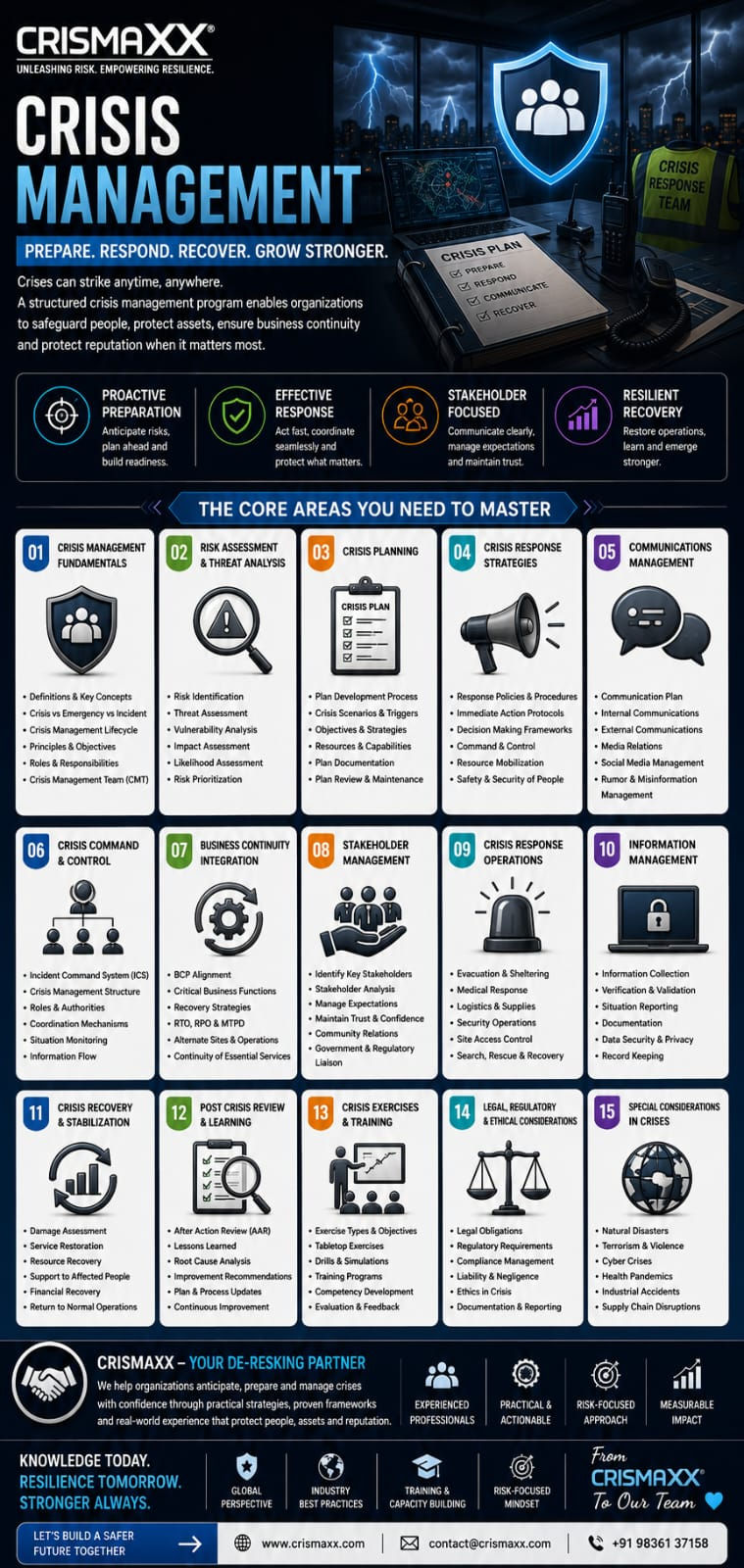
Crisis Management
No organization is immune to crisis. Whether triggered by natural disasters, cyber incidents, workplace violence, supply chain disruptions, public health emergencies, or reputational events, crises demand decisive leadership, structured decision-making, and organizational resilience. The Crisis Management domain equips security professionals with the knowledge and leadership capabilities to prepare for, respond to, recover from, and learn from disruptive events while protecting people, assets, operations, and organizational reputation.
The curriculum adopts a lifecycle approach to crisis management, beginning with risk assessment and preparedness before progressing through planning, response, recovery, and continuous improvement. Professionals develop competencies in crisis planning, command and control structures, emergency communications, stakeholder engagement, business continuity integration, resource coordination, and incident management. Throughout the domain, emphasis is placed on informed decision-making under pressure, cross-functional coordination, and maintaining operational continuity during periods of uncertainty.
Beyond immediate response, the domain recognizes that organizational resilience is built through continuous learning and adaptation. Security leaders learn to conduct post-crisis reviews, evaluate organizational performance, refine response strategies, strengthen governance, and improve preparedness through training and realistic exercises. The result is an organization capable not only of managing crises effectively but also of emerging stronger, more resilient, and better prepared for future disruptions.
Key Areas of Coverage
Crisis management principles, governance, and the crisis management lifecycle
Risk identification, threat assessment, vulnerability analysis, and crisis preparedness
Crisis planning, strategy development, resource management, and plan maintenance
Crisis response policies, decision-making frameworks, and emergency response coordination
Internal, external, executive, media, and stakeholder communications
Crisis Management Team (CMT) structures, command and control, coordination, and situational awareness
Integration of crisis management with business continuity and organizational resilience
Stakeholder identification, engagement, expectation management, and public confidence
Operational response, evacuation, life safety, logistics, and resource mobilization
Information management, documentation, reporting, data protection, and record management
Recovery planning, stabilization, restoration of operations, and organizational recovery
Post-incident reviews, lessons learned, root cause analysis, and continual improvement
Crisis exercises, simulations, training, competency development, and preparedness validation
Legal, regulatory, ethical, and governance considerations during crisis events
Management of diverse crisis scenarios, including natural disasters, cyber incidents, terrorism, industrial accidents, public health emergencies, and supply chain disruptions
Executive Insight: Crisis Management is the ultimate test of organizational leadership and resilience. It enables security professionals to transform uncertainty into coordinated action, ensuring that organizations not only withstand disruptive events but recover stronger, protect stakeholder confidence, and sustain long-term business continuity.

From Theory to Practice
How CPP Transforms Security Leaders
The true value of the Certified Protection Professional (CPP) lies not in the breadth of its curriculum, but in its ability to transform knowledge into leadership. While the Body of Knowledge is academically rigorous, its ultimate purpose is deeply practical—preparing professionals to solve complex security challenges, make strategic decisions, and create measurable value for their organizations.
Unlike certifications that focus primarily on technical competencies, the CPP develops a multidisciplinary perspective. Security professionals are encouraged to think beyond incidents and protective measures, understanding how security intersects with governance, enterprise risk management, business continuity, finance, investigations, crisis leadership, information security, and organizational strategy. This broader perspective enables security leaders to move confidently from operational execution to executive decision-making.
Throughout the certification journey, candidates are challenged to analyse situations, evaluate competing priorities, assess risk, and recommend solutions that balance security objectives with business needs. The emphasis is not on memorizing facts, but on applying established principles to real-world scenarios where uncertainty, resource constraints, and competing stakeholder interests are everyday realities.
The CPP also fosters a strategic mindset by encouraging professionals to communicate in the language of business. Whether justifying security investments through cost-benefit analysis, presenting risks to executive leadership, designing resilient security programs, or leading organizations through crises, CPP-certified professionals are equipped to demonstrate how security contributes directly to organizational performance and long-term resilience.
Perhaps the most significant transformation occurs in how professionals perceive their role. They evolve from managing security functions to influencing organizational strategy. They become trusted advisors who anticipate emerging risks, strengthen governance, support executive leadership, and embed security into the fabric of business operations.
The result is a professional who is not only technically proficient but also strategically aware, commercially informed, and capable of leading security as a business enabler. This transformation is precisely why the CPP continues to be recognized worldwide as the benchmark for excellence in security management.
The CPP does not simply prepare professionals to manage security—it prepares them to lead organizations through uncertainty, influence executive decisions, and transform security from an operational necessity into a strategic business advantage.
Common Myths About the CPP Certification
The Certified Protection Professional (CPP) has earned a reputation as one of the world's most respected security management credentials. However, with that reputation comes a number of misconceptions that often discourage capable professionals from pursuing certification. Separating fact from fiction is essential for anyone considering the CPP as part of their professional development journey.
Myth 1: The CPP is only for physical security professionals.
Reality: While physical security remains an important component, the CPP encompasses far more than guarding operations, access control, and surveillance. Its Body of Knowledge spans enterprise security risk management, governance, investigations, personnel security, crisis management, business continuity, information security, business principles, and executive leadership. It is designed for professionals responsible for managing security as an integrated business function.
Myth 2: The CPP is purely theoretical.
Reality: The certification is built around practical application. Candidates are expected to analyse complex scenarios, assess risk, make informed decisions, and apply security principles to real-world business challenges. Success depends on sound judgement and professional experience rather than memorization alone.
Myth 3: The CPP is only relevant in the United States.
Reality: The CPP is a globally recognized certification held by professionals across government agencies, multinational corporations, consulting firms, critical infrastructure operators, financial institutions, healthcare organizations, and educational institutions worldwide. Its principles are universally applicable because they are based on internationally accepted security management practices.
Myth 4: Only senior executives should pursue the CPP.
Reality: Although candidates must meet ASIS eligibility requirements, the certification benefits professionals at various stages of leadership. Security managers, consultants, investigators, risk professionals, and emerging leaders often pursue the CPP to strengthen their strategic capabilities and prepare for broader leadership responsibilities.
Myth 5: Passing the examination is the ultimate objective.
Reality: Earning the credential is only the beginning. The real value of the CPP lies in the professional growth it inspires. The knowledge, analytical thinking, and strategic perspective gained throughout the journey continue to shape decision-making long after the examination has been completed.
Myth 6: The CPP is relevant only to large multinational organizations.
Reality: The principles taught within the CPP are scalable. Whether supporting a manufacturing facility, healthcare institution, technology company, educational campus, financial organization, or multinational enterprise, the concepts of governance, risk management, resilience, and security leadership remain equally valuable.
Myth 7: The CPP is only for security professionals.
Reality: Many professionals whose responsibilities intersect with organizational risk—including business continuity managers, resilience professionals, investigators, loss prevention specialists, compliance officers, risk managers, and corporate leaders—find significant value in the strategic perspective developed through the CPP.
The CPP is not simply an examination—it is a professional development journey that broadens perspectives, strengthens leadership capabilities, and equips security professionals to operate confidently at both the operational and executive levels. Those who view it solely as a certification often overlook its greatest value: the transformation in how security is understood, communicated, and led.

Preparing for Success
A Strategic Approach to the CPP Examination
Achieving the Certified Protection Professional (CPP) credential is not simply about passing an examination—it is about developing the mindset, judgment, and leadership capabilities expected of today's security executives. The breadth of the CPP Body of Knowledge demands far more than memorization; it requires structured preparation, disciplined study, practical application, and a clear understanding of how the various domains interconnect within modern security management.
Successful candidates approach the examination strategically. They establish realistic study plans, master the underlying concepts before attempting practice questions, evaluate their strengths and weaknesses through regular assessments, and continuously refine their understanding using real-world scenarios. Equally important is exposure to examination-style questions that challenge analytical thinking, decision-making, and the application of professional judgement—skills that define both the examination and the role of an effective security leader.
Many aspiring CPP professionals underestimate the importance of guided preparation. While self-study remains valuable, structured mentorship significantly accelerates learning by providing expert insights, practical context, accountability, and personalized feedback. Learning directly from experienced practitioners enables candidates to bridge the gap between theory and practice while avoiding many of the common pitfalls encountered during independent preparation.
At CRISMAXX, we have designed our certification ecosystem around one objective—to help security professionals not only succeed in the CPP examination but also develop into confident, strategic security leaders capable of creating measurable business value.

CRISMAXX Elite Comprehensive Mentorship
Our flagship mentorship program is built for professionals seeking a structured, instructor-led learning experience. Rather than relying solely on recorded content, participants engage in live, mentor-led sessions that simplify complex concepts, relate them to real-world security challenges, and develop the analytical thinking expected of CPP-certified professionals.
The program combines:

Comprehensive coverage of the entire CPP Body of Knowledge
Live interactive mentor-led sessions
Personalized guidance and one-to-one mentor interaction
Strategic examination planning and study roadmaps
CBT-style examination simulations
Performance analytics with individualized feedback
Practical case studies and real-world application of security concepts
Whether you are preparing for your first attempt or refining your approach after previous examinations, the mentorship program provides the structure, accountability, and expert guidance needed to maximize your chances of success.

CRISMAXX Mock Examination Bundle
Knowledge alone is not enough—exam readiness comes through consistent practice.

Our CPP Mock Examination Bundle has been developed to replicate the style, complexity, and decision-making approach of professional certification examinations. Candidates gain exposure to realistic examination environments while identifying knowledge gaps before the actual test.
The bundle includes:
A minimum of 10 comprehensive mock examinations
Computer-Based Testing (CBT) simulation
Timed assessments that mirror examination conditions
Domain-wise performance evaluation and analytics
Flexible self-paced learning from anywhere
These mock examinations are designed not merely to assess knowledge but to build confidence, improve time management, and strengthen examination strategy.
Why Professionals Choose CRISMAXX
At CRISMAXX, our mission extends beyond certification preparation. We are committed to developing security professionals who can think strategically, communicate effectively with executive leadership, and lead resilient security programs in an increasingly complex risk environment.
Our programs are built upon:
Practitioner-led instruction grounded in real-world experience
A globally aligned curriculum reflecting international best practices
Strategic mentorship rather than rote learning
Continuous assessment and performance improvement
A commitment to developing future security leaders—not simply examination candidates
Whether your goal is to achieve the prestigious CPP credential, advance into executive security leadership, or broaden your expertise in enterprise risk management, CRISMAXX provides the knowledge, mentorship, and practical guidance to help you succeed.
Certification is a milestone—not the destination. The most successful CPP professionals invest not only in passing the examination but in transforming the way they think, lead, and create value. At CRISMAXX, that transformation begins long before the examination day and continues throughout your professional journey.
Ready to Begin Your CPP Journey?
CRISMAXX offers premium mentor-led certification programs and comprehensive mock examination bundles designed to help ambitious security professionals achieve global standards of excellence.
✔ Elite Comprehensive Mentorship – Live classes, strategic mentoring, personalized guidance, CBT simulations, and performance evaluation.
✔ CPP Mock Examination Bundle – Minimum 10 CBT-style mock examinations, domain-wise analytics, timed assessments, and self-paced preparation.
Build Knowledge. Develop Leadership. Earn Global Recognition.
Prepare with Confidence.
Prepare with CRISMAXX.


Comments